
Appearance
Competitor Analysis
Quick Answer
Competitor insights in Zeus.ai are currently spread across map layers, nearby business context, and other analytics such as Forecast Drivers rather than a single guaranteed Competitor Analysis section.
What Competitor Analysis Shows
Competitor Count
- Number of competitors nearby
- Within various radii (1 mi, 3 mi, 5 mi)
- By category or type
- Direct vs indirect competitors
Competitor Locations
- Map view of competitor sites
- Distance to each competitor
- Competitor density patterns
- Clustering of competition
Competitive Impact
- How competition affects revenue estimates
- Market share considerations
- Saturation indicators
- Opportunity gaps
Types of Competitors
Direct Competitors
- Same business type as you
- Competing for same customers
- Most important to track
Indirect Competitors
- Related businesses
- Partial customer overlap
- May still impact performance
Category Examples
| Your Business | Direct | Indirect |
|---|---|---|
| Fast Food | Other fast food | Casual dining |
| Gym | Other gyms | Home fitness |
| Coffee | Coffee shops | Fast food breakfast |
Competitor Metrics
Distance-Based
| Metric | Description |
|---|---|
| Nearest competitor | Distance to closest |
| Within 1 mile | Count in immediate area |
| Within 3 miles | Count in trade area |
| Within 5 miles | Count in broader market |
Density Metrics
- Competitors per square mile
- Competition saturation score
- Market concentration
Performance Indicators
- Competitor estimated volumes
- Market share distribution
- Growth trends (if available)
Reading Competitor Data
Competitor List
Shows each competitor with:
- Name/brand
- Address
- Distance from your site
- Category/type
- Performance estimate (if available)
Competition Score
A summary metric indicating:
- Low competition: Few competitors, good opportunity
- Moderate competition: Normal competitive environment
- High competition: Saturated market, harder to capture share
Map Visualization
- Your site marked centrally
- Competitors shown as markers
- Color/size may indicate type or volume
- Radius rings show distances
Using Competitor Analysis
Site Evaluation
- How many competitors are nearby?
- Is this more or less than comparable sites?
- Are there gaps in competition coverage?
Strategy
- Where are competitors weak?
- What's your differentiation?
- Can you capture market share?
Risk Assessment
- Could more competitors enter?
- Are competitors expanding?
- What's the market's capacity?
Finding Competitor Insights
On the Map
- Use map layers, site visibility, and nearby business context
- Compare the selected site against visible surrounding locations
- Identify clusters, gaps, and density visually
In Analytics
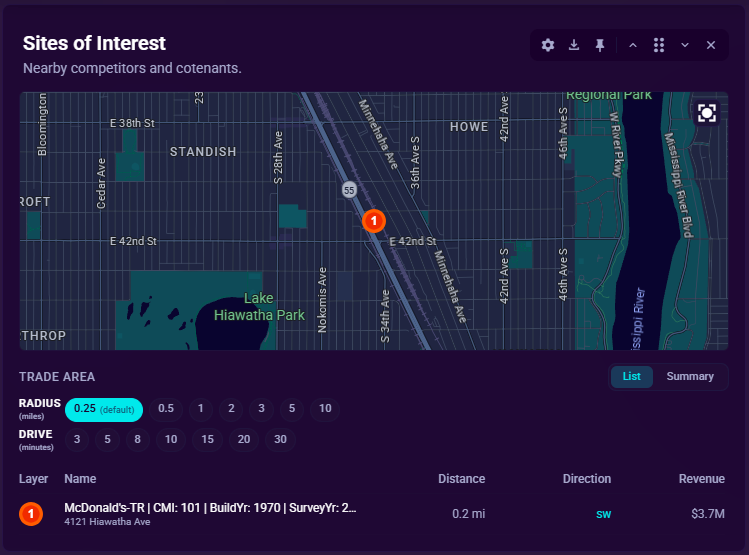
The closest thing to a standalone competition panel is the Sites of Interest section in Location Analytics, described in-app as "Nearby competitors and cotenants." Beyond that, look for competition-related context inside broader analytics rather than assuming a dedicated competition panel is always present elsewhere.
Through AI Assistant
Ask questions like:
- "What competitors are near this location?"
- "How does competition here compare to other sites?"
- "Is this market saturated?"
Tips for Competitive Analysis
Quality Over Quantity
- Not all competitors equal
- Strong vs weak competitors
- Local vs national chains
Consider Trends
- Are competitors growing or shrinking?
- New entrants coming?
- Closures/exits?
Look for Co-tenancy
- Some competitors attract traffic
- Shopping centers bring customers
- Competition can be positive
Market Capacity
- How much total demand?
- Can market support another location?
- Room for growth?
Competition Impact on Zeustimate
How It's Factored
- More competition typically = lower estimate
- But not always negative
- Market viability indicator
- Variable importance shows weight
Interpreting Impact
- Check variable importance
- If competition is small factor: other drivers matter more
- If competition is large factor: competitive environment is key
Common Questions
Is More Competition Bad?
Not always. Competition indicates:
- Proven market demand
- Traffic generators nearby
- But also market share challenge
What's the Right Amount?
Depends on:
- Your business model
- Market size
- Differentiation strategy
How to Compete?
Consider:
- Location advantages
- Service/product differentiation
- Marketing and awareness
- Price/value positioning